
This article was written by Public Information Officer Tre’ Keys, of Far Northern Regional Center. An earlier version first appeared on FNRC’s Inclusion Fusion newsletter’s Spring 2026 issue.
“I love the outdoors. I love nature, and I love just walking around helping people and providing information,” said Michael Oliver.
Michael’s journey with California State Parks has come full circle.
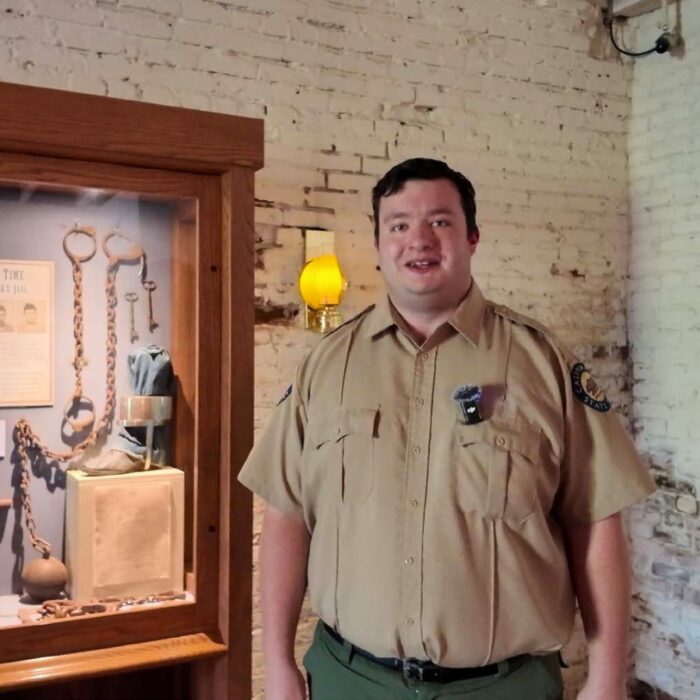
After beginning as an intern at Ide Adobe State Park, Michael has been officially hired as a park aide at Shasta State Historic Park. He describes the role as both unexpected and deeply rewarding.
“When I heard I got the job, I felt like this is just a total victory,” he said. “What made it phenomenal was the fact that I graduated college and I got into this position. So it was just two victories in one year. So it’s like I was just blown away.”
Michael, 28, worked with his Far Northern Regional Center service coordinator and Mains’l Services to receive job and college coaching. He also received placement for two paid internships with California State Parks. It was during this time that Michael realized this work could become a long-term career.
At Shasta, his responsibilities include ensuring guests receive accurate information about what he calls Ide Adobe’s “cultural and diverse historical” significance. He also cleans debris, preserves artifacts and maintains plexiglass displays that allow visitors to view items inside the courthouse museum.
Michael said his previous experience working outdoors and in maintenance roles helped prepare him for the job.
“I’ve worked in maintenance areas, attending overseeing some parks as well — not state, but rest areas,” he said. “I really know what it means to really keep a place nice and memorable for many people who wish to visit.”
Michael said his passion for education has shaped his approach to storytelling at the park. While at Shasta, he also obtained two associate degrees, one in Social Studies and one in History.
“There’s a lot of history that people need to have historical agency with,” Michael said. “I’m not just talking about the pioneer cowboy. I’m talking about including a diverse range of topics where people feel that they are part of something even greater.”
Michael said he has been surprised by the cultural diversity of local history, including stories about African American and Chinese American contributions to the region.
Michael, who was diagnosed with Asperger’s syndrome as a child, said he hopes his story encourages others.
“I had a lot of self-doubt growing up,” he said. “I just hope that my story is able to really give hope to people who think that there is none — because there is hope. There’s hope for a lot of people, and there’s a chance for everybody to do what I did.”
Looking ahead, Michael would like to attend a 4-year college program and major in History. He also hopes to continue growing within the park system, possibly in an interpreter or in a research role.
“I would love to definitely be part of a research team effort to where I can pick and pinpoint information,” he said. “I really like to really help find information — oral histories for others.”
For now, Michael said he is grateful to be doing work he loves.
“It’s a great opportunity,” he said.